Mastering trigonometry isn't just an academic necessity; it's the master key to understanding how waves, buildings, and even planetary orbits are structured. If you've ever felt overwhelmed by a tangle of identities, angles, and functions that seem endless, you're not alone. Many students and professionals see this field as an insurmountable obstacle, but the reality is that trigonometry is a logical, elegant, and, above all, highly applicable tool.
The Problem of Mathematical Abstraction
Problem: Most educational texts present trigonometry as a set of isolated formulas. Students memorize that sine is "opposite over hypotenuse" without truly understanding what that relationship means in two-dimensional space or how it connects to rational numbers. This disconnect creates frustration and superficial learning that fades after the exam.
Agitation: Imagine trying to design a bridge, program a 3D video game, or even adjust the acoustics of a room without understanding trigonometric functions. The smallest error in calculating an angle can lead to the collapse of a structure or software full of bugs. The lack of technical depth not only affects your grades but your ability to solve real-world problems in STEM.
Solution: In this article, we will break down trigonometry from its purest fundamentals to its most complex applications. You will learn to visualize the unit circle, manipulate functions with precision, and understand why this branch of mathematics is the language of the physical universe. Welcome to the guide that will transform your perception of angles.
Essential Fundamentals: What is Trigonometry?
The word trigonometry comes from the Greek trigonos (triangle) and metron (measure). In essence, it is the study of the relationships between the sides and angles of triangles. Although it began focused on right triangles, its evolution has led it to describe cyclical phenomena and waves, becoming an indispensable branch of mathematical analysis.
The Right Triangle: The Cradle of Functions
Everything begins with the right triangle (one that has a 90° angle). From here, we define the three fundamental functions in relation to an acute angle :
- Sine (): The ratio between the length of the side opposite to the angle and the hypotenuse.
- Cosine (): The ratio between the length of the side adjacent to the angle and the hypotenuse.
- Tangent (): The ratio between the opposite side and the adjacent side.
These definitions are crucial because they establish constant proportions. It doesn't matter if the triangle is small or giant; if the angles are equal, the trigonometric ratios will be identical. This is where rational numbers come into play, as many of these ratios are expressed as exact fractions at notable angles.
The Unit Circle: The Map of Modern Trigonometry
To take trigonometry beyond simple triangles and apply it to angles of any measure (even negative ones), we use the unit circle. This is a circle with a radius equal to 1, centered at the origin of the Cartesian plane.
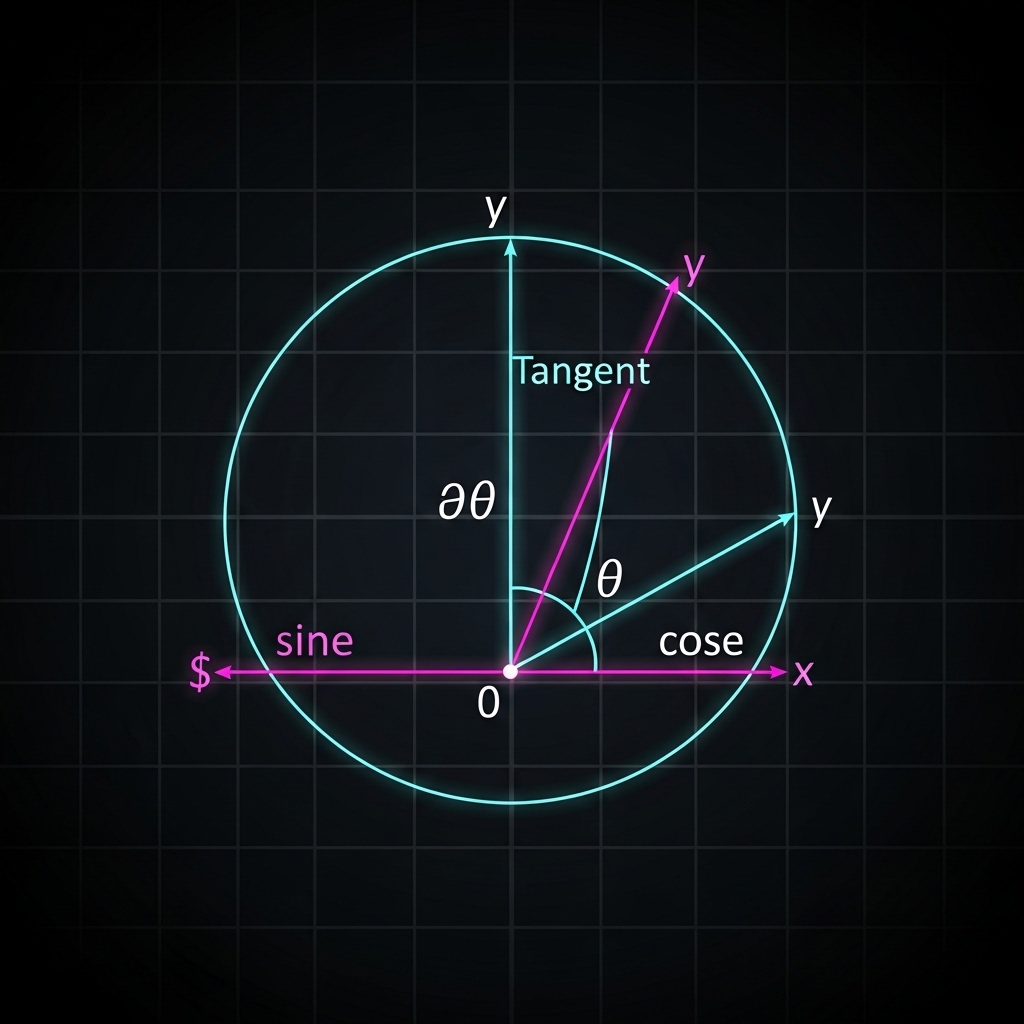
In this model, any point on the circumference represents the functions of an angle :
- The coordinate corresponds to .
- The coordinate corresponds to .
- The slope of the line joining the origin to the point is .
Importance of Quadrants
The Cartesian plane is divided into four quadrants, and the sign of trigonometric functions depends on where the terminal side of the angle is located:
- Quadrant I (0° to 90°): All functions are positive.
- Quadrant II (90° to 180°): Only sine (and its reciprocal, cosecant) is positive.
- Quadrant III (180° to 270°): Only tangent (and cotangent) is positive.
- Quadrant IV (270° to 360°): Only cosine (and secant) is positive.
Trigonometric Functions: Definitions and Properties
To master trigonometry, it is vital to understand not only the three basic functions but also their reciprocals and how they behave analytically.
1. The Sine Function ()
Sine represents the vertical projection of a point on the unit circle. Its main characteristics are:
- Domain: All real numbers ().
- Range: . You will never see a sine greater than 1 under normal conditions.
- Periodicity: It repeats every radians (360°).
2. The Cosine Function ()
It represents the horizontal projection. It is, in essence, a sine shifted to the left.
- Domain: All real numbers.
- Range: .
- Parity: It is an even function, meaning .
3. The Tangent Function ()
Unlike sine and cosine, tangent has vertical asymptotes where cosine is zero (for example, at 90° or 270°).
- Definition: .
- Range: .
Reciprocal Functions
It is a common error to confuse inverse functions (like arcsine) with reciprocals. The reciprocals are:
- Cosecant ():
- Secant ():
- Cotangent ():
Fundamental Trigonometric Identities
Identities are equations that are valid for all values of the domain. They are the "transformation rules" that allow you to simplify complex expressions.
Pythagorean Identities
Based on the Pythagorean Theorem (), the most important identity is:
From this, we can derive:
These relationships are the basis for solving trigonometric equations and performing integrations in advanced calculus.
Angle Measurement: Degrees vs. Radians
In the academic and professional world, the use of radians often surpasses that of degrees. A radian is the angle subtended at the center of a circle by an arc whose length is equal to the radius of the circle.
Key Conversion: radians.
Why Use Radians?
In calculus and physics, the derivatives of trigonometric functions are much simpler when working in radians. For example, the derivative of is only if is in radians.
If you work with rational numbers, you will see that the most common angles are expressed as fractions of :
BLOCK 2: Advanced Trigonometry, Rational Numbers, and Real-World Applications
Entering the realm of advanced trigonometry means stopping viewing angles as simple openings and starting to see them as deep numerical relationships. One of the most fascinating and least explained connections in classrooms is the direct link between trigonometric functions and rational numbers. This relationship not only facilitates mental calculation but is the basis of precision in engineering and architecture.
The Critical Connection: Trigonometry and Rational Numbers
In mathematics, a rational number is one that can be expressed as the quotient of two integers (, where ). When we study trigonometry, we often encounter irrational numbers (like or ), but the essence of problem-solving in STEM often lies in finding exact rational proportions.
Pythagorean Triples: Rationality in Its Purest Form
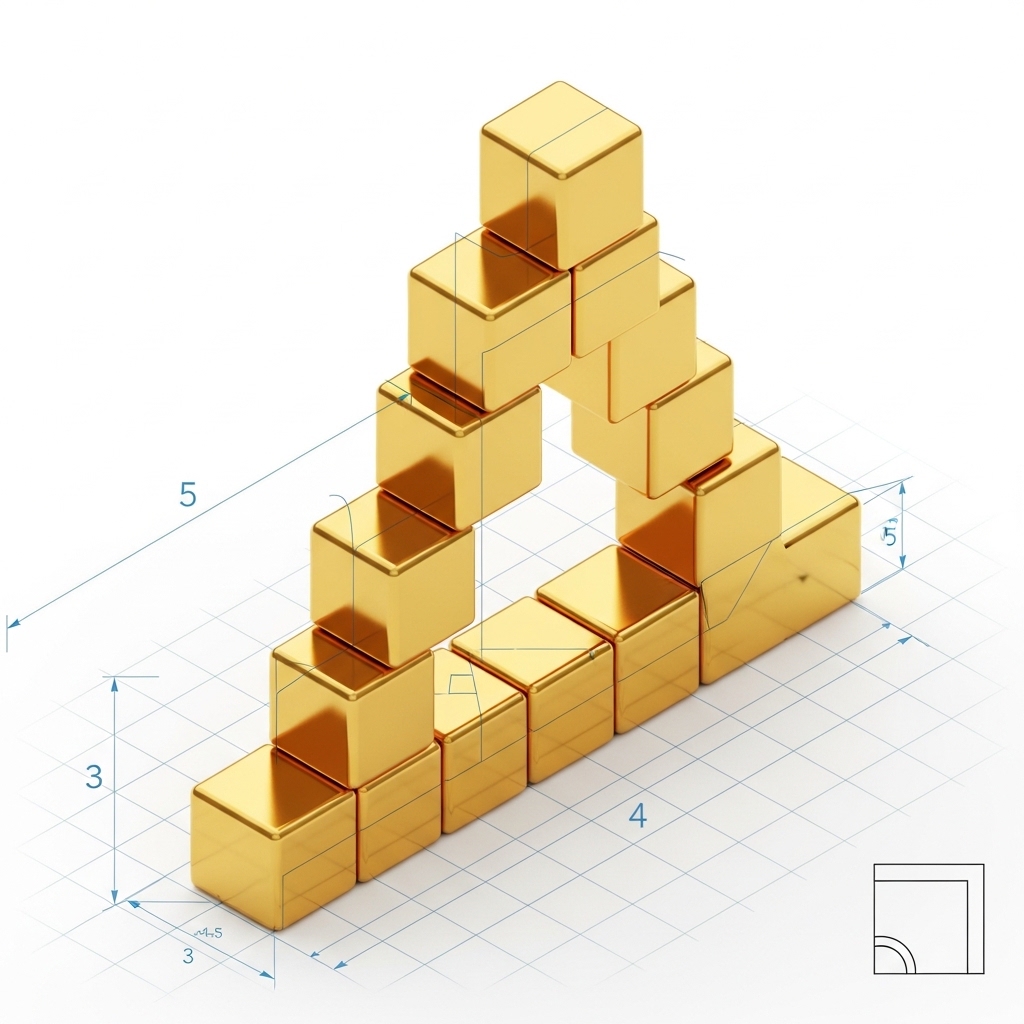
Pythagorean triples are sets of three positive integers that satisfy the equation . The most famous example is the triangle .
- In this case, the of one of its angles is (0.6) and the is (0.8).
- Both results are exact rational numbers.
This property is vital because it allows engineers and designers to work with precise measurements without carrying decimal rounding errors. If you can configure a structure based on rational number proportions, the stability of the design increases exponentially.
Notable Angles and Their Exact Values
Although many trigonometric values are irrational, the "notable angles" (, , ) are the cornerstone because their functions are derived from perfect geometric figures (the square and the equilateral triangle). By rationalizing denominators, we obtain standard values that every student must master to accelerate their learning.
High-Impact Applications in Engineering and Physics
Trigonometry is not a dead theory; it is the engine that drives modern technology. Without the precise calculation of sines and cosines, most of the advances we take for granted would collapse.
1. Civil and Structural Engineering
Every time you see a suspension bridge or a skyscraper, you are seeing trigonometry in action. Engineers use force decomposition through trigonometric functions to ensure that weight (vertical vector) and wind forces (horizontal vectors) are distributed correctly across beams.
- Stress Analysis: Sines and cosines are used to calculate the load on each member of a truss.
- Slopes and Ramps: The use of tangent is fundamental to determine the safe inclination of roads and drainage systems.
2. Physics: Harmonic Motion and Waves
This is where trigonometry becomes dynamic. Almost everything in the physical universe vibrates or fluctuates. From the sound waves you hear to the light you see and the alternating current that powers your home.
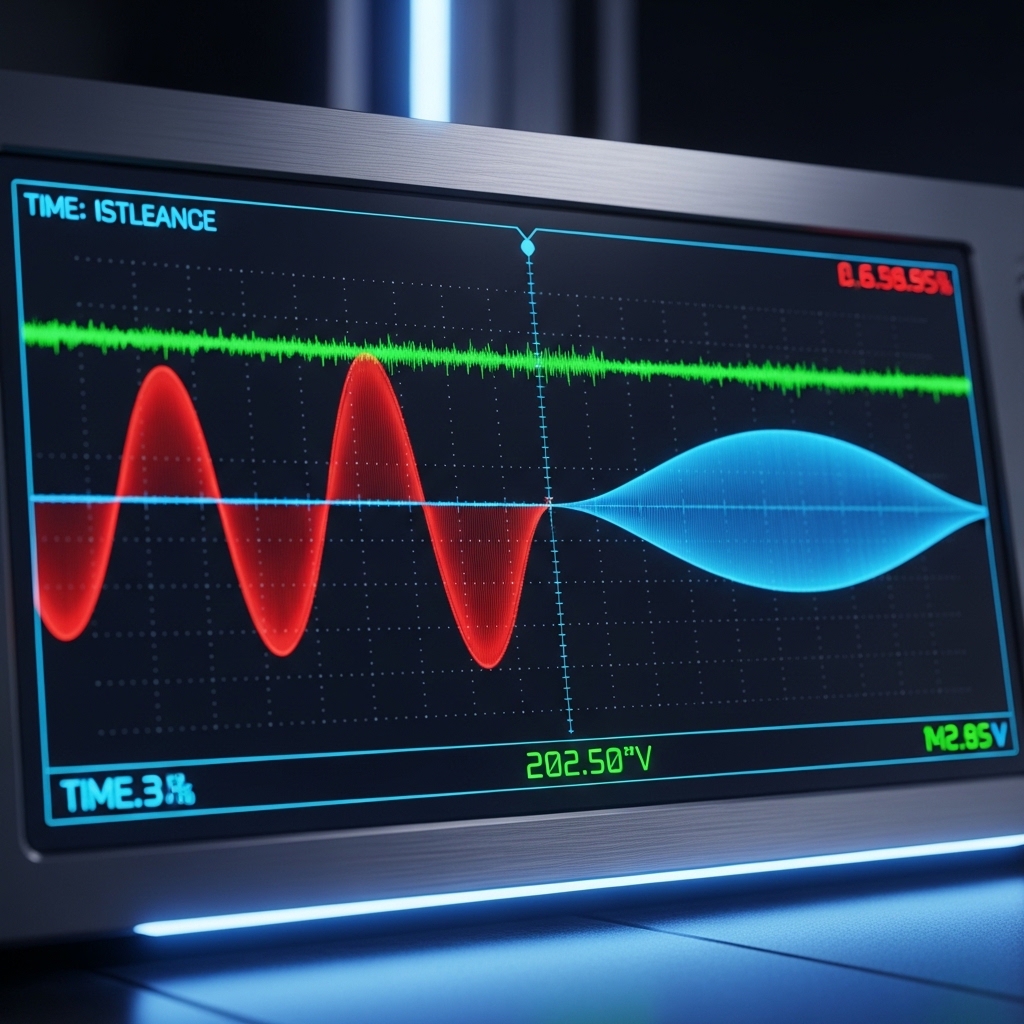
- The Sine Function as a Model: The motion of a pendulum or the vibration of a guitar string is modeled by the function .
- Electronics: Alternating current (AC) changes its direction and magnitude in a sinusoidal manner. Understanding peak values and phase (horizontal displacement) is crucial for any electrician or electronics engineer.
🚀 Master Mathematics with Fun
Do you feel like there's a lot of theory but you lack practice? The best way to consolidate these trigonometry and rational number concepts is through constant challenge.
We recommend downloading TriviaMath Uno, the app designed to transform your learning into a game of strategy and mental agility. Test your knowledge of functions, angles, and STEM problems anywhere.
👉 Download TriviaMath Uno here and elevate your math level today.
Deep Analysis of Waves and Periodicity
Continuing with physics, it is imperative to understand the concept of frequency and period. A trigonometric function is not just a curve; it is a representation of time and repetition.
The Concept of Phase and Amplitude
When we analyze sinusoidal waves in a professional setting (such as in telecommunications), we modify the basic function using three parameters:
- Amplitude (): How "tall" the wave is. In sound, this is volume; in electricity, voltage.
- Frequency (): How many cycles occur in a given interval. Determines the pitch of a musical note.
- Phase Shift (): The start of the wave in time. Two waves of the same frequency can cancel each other out if they are "out of phase," a principle used in noise-canceling headphones.
Trigonometry in Navigation and GPS
How does your phone know exactly where you are? The GPS system uses a process called trilateration. Satellites in orbit send signals, and your device calculates the distance based on the time it takes for the signal to arrive. To convert those distances into a precise location (latitude and longitude) on a curved Earth, spherical trigonometry is used. Unlike the planar version, here the angles of triangles add up to more than , but the fundamentals of sine and cosine remain the core of the calculation.
The Importance of Identity in Problem Solving
To advance to the next level, we must stop viewing formulas as static. In software engineering and video game development, for example, angle addition and subtraction identities are used to rotate objects on the screen.
If you want to rotate a point by an angle , the new coordinates are calculated using:
This is a practical use of trigonometry that connects directly to linear algebra. Without these formulas, the 3D graphics we see in movies and games would be impossible to render.
BLOCK 3: Solving Complex Problems and the Future of Your Learning
At this point, you already understand the theoretical pillars of trigonometry and how rational numbers bring precision to engineering calculations. However, true mastery of STEM mathematics is demonstrated in the ability to solve complex problems where multiple concepts converge. In this block, we will address step-by-step resolution methodologies and tools to consolidate your academic success.
Step-by-Step Resolution: The Law of Sines and Cosines
When we work with non-right triangles (oblique triangles), the basic definitions of sine and cosine need an expansion. This is where the most powerful tools of plane trigonometry come in.
Case Study: Calculating Inaccessible Distances
Imagine you need to calculate the distance between two points, A and B, separated by a river. You cannot measure the distance directly, but you can measure a baseline from a point C and the angles formed.
- Data Identification: Suppose you know side meters and angles and .
- Using the Law of Sines: The relationship states that .
- Calculating the Missing Angle: Since the sum of interior angles is always , angle .
- Substitution: .
- Result: meters.
This type of logic is what modern surveyors use to map rugged terrain with millimetric precision.
Technical Comparison: Functions vs. Identities
It is common for students to confuse when to apply a function and when to transform an identity. The following table summarizes the key differences for your study:
| Characteristic | Trigonometric Functions | Trigonometric Identities |
|---|---|---|
| Definition | Relationship between an angle and a ratio of sides. | Equations that are true for any angle. |
| Main Use | Find unknown values (sides/angles). | Simplify expressions and solve integrals. |
| Example | ||
| Result | A numerical value (often a rational number). | A simpler equivalent expression. |
Real-Life Applications of Trigonometry
We often ask ourselves: "When am I going to use this?" The answer is that trigonometry is the invisible scaffolding of the modern world. From medicine to entertainment, its impact is total.
- Medicine (Ultrasounds and ECGs): Diagnostic equipment processes sound and electrical waves using Fourier transforms, which depend entirely on trigonometric functions.
- Bioclimatic Architecture: Calculation of roof inclination and window position based on the angle of incidence of sunlight at different times of the year.
- Astronomy: Measuring the distance to nearby stars using the stellar parallax method, which is nothing more than a gigantic triangulation problem.

How to Go from Theory to Mastery
The gap between understanding a concept and successfully applying it in an exam or professional project is closed with deliberate practice. It's not enough to read; you have to solve. However, traditional paper problem-solving can become monotonous.
The Role of Technology in STEM Learning
Today, we have tools that make learning trigonometry and rational numbers interactive. Mobile applications have been shown to increase retention of complex concepts by up to 40% by engaging the brain's reward system through gamification.
This is where tools like TriviaMath Uno make a difference. They not only present you with the problem but force you to think fast, identify the concept (is it sine or cosine?), and execute the mental calculation needed to advance.
Conclusion and Next Steps
Trigonometry is much more than the study of triangles. It is a discipline that connects pure geometry with wave analysis, structural engineering, and quantum physics. By mastering the unit circle, understanding the importance of rational numbers in proportions, and knowing how to apply fundamental identities, you have acquired one of the most valuable skills in the STEM ecosystem.
Summary of what you learned:
- Solid fundamentals through the unit circle and basic functions.
- The importance of rational precision in engineering and wave physics.
- Strategies for solving complex problems in a structured way.
Take Your Skills to the Next Level!
Don't let this knowledge rust. The key to being a math expert is constant challenge. If you want to master every angle, every formula, and every numerical relationship in an agile and fun way, we have the perfect tool for you.
Are you ready to become a trigonometry master?
👉 Download TriviaMath Uno on Google Play or the App Store and start competing with users from around the world while strengthening your brain. Mathematics was never the same.