The Ultimate Guide to Synonyms and Antonyms: Master the Spanish Language
Meta-description: Master Spanish with our Ultimate Guide to Synonyms and Antonyms. Improve your lexical richness, avoid cacophony, and optimize your SEO. Enter now! URL Slug: /the-ultimate-guide-to-synonyms-antonyms/
1. Introduction: The Architecture of Meaning
The Spanish language, with its vast inventory of more than 93,000 words registered in the Dictionary of the Spanish Language (DLE), is not simply a static repertoire of labels to designate reality. It is, in essence, a living organism, an architecture of thought where each term possesses a genetic load, a historical texture, and a specific nuance that makes it unique. At the epicenter of this complex linguistic machinery are synonyms and antonyms, the fundamental tools of semantics that allow the speaker and professional writer to transition from mere communicative survival to expressive mastery.
1.1 Etymological Definition: The Origin of Duality
Etymologically, the word synonym comes from the Greek synonymos, a construction of syn (with, union) and onoma (name). It represents the search for affinity, for conceptual companionship. On the other hand, antonym is born from anti (against) and onoma, representing the necessary dialectic to define the limits of the world. This root reveals a profound philosophical truth: language operates through association and contrast. We cannot fully understand the concept of "freedom" if we are not able to articulate its opposition in "servitude," nor can we exalt "beauty" without a range of terms that grade it, from the "attractive" to the "sublime" or the "aesthetic."
1.2 Lexical Richness: The Superpower of the 21st Century
In 2025, lexical richness has ceased to be a quality reserved for academics or poets to become the ultimate superpower of the digital era. In an information-saturated environment, where attention span is measured in milliseconds, terminological precision is what differentiates a thought leader from an average communicator. The exact word eliminates ambiguity, reduces cognitive friction, and generates an immediate emotional connection with the receiver.
Mastering synonyms and antonyms allows us to break the chains of "rag tongue" —that limited and repetitive vocabulary— to build discourses that possess authority, elegance, and effectiveness. This guide is not just a grammatical resource; it is a map to navigate the depths of Spanish and transform your writing into a tool of surgical precision.

2. The Universe of Synonyms: Beyond Superficial Similarity
Synonymy is technically defined as the relationship of identity or similarity of meanings between different lexical units. However, for the rigorous philologist, "perfect synonymy" is an extremely rare phenomenon, almost a linguistic unicorn. Language naturally tends toward economy and differentiation; therefore, it is unusual for two terms to mean exactly the same in all imaginable contexts.
2.1 Total vs. Partial Synonymy: The Myth of Absolute Equivalence
It is imperative that the professional writer distinguishes between these two concepts to avoid register errors that can undermine their credibility.
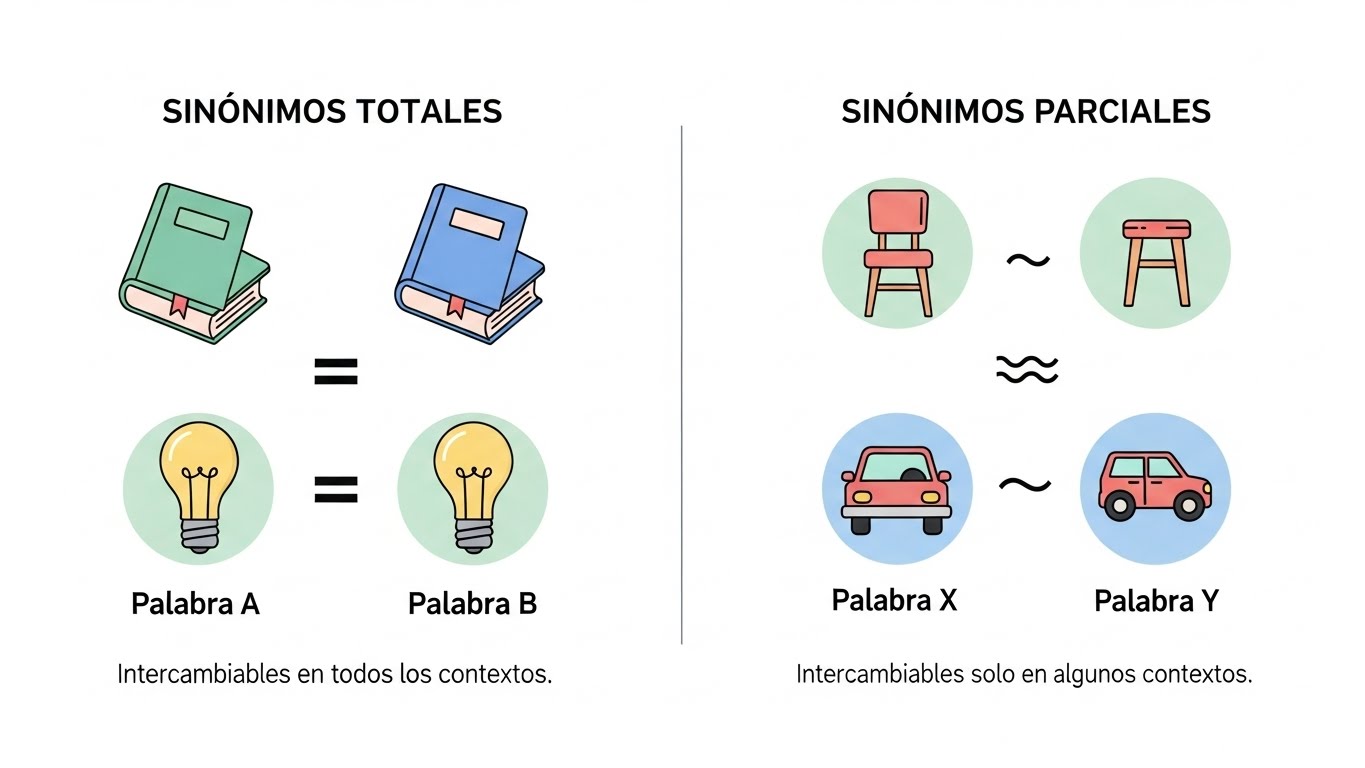
A. Total (or Absolute) Synonymy
It occurs when two words are interchangeable in any context without producing the slightest alteration in the meaning, intention, or tone of the message. These cases are scarce and are usually limited to regional variants or specific technical terminology.
- Examples: Odontologist and dentist; begin and start; donkey and ass.
- Professional use: They are useful to avoid repetition in technical manuals or texts where the precision of the referent is all that matters.
B. Partial (or Contextual) Synonymy
It is the predominant form in Spanish. Two terms share a core of meaning, but their "peripheries" of meaning differ according to the situation. The success of their use depends entirely on the linguistic context.
- The case of "Heavy": A package can be heavy or bulky. However, if we refer to an annoying person, we can say they are heavy, but we would never say they are bulky with the same meaning.
- The case of "Altered": An exam can be altered (modified), and a person can be altered (nervous). Here, the terms "modified" and "nervous" are partial synonyms of "altered," but they are not interchangeable with each other.
2.2 Referential and Connotation Synonymy: The Power of Nuance
To elevate the quality of a text, we must understand that words not only designate objects but also carry subjective values and feelings.
- Referential Synonymy: It occurs when two terms refer to the same real referent, although their dictionary definitions do not coincide. It is a masterful tool for storytelling and journalism.
- Example: When speaking of Miguel de Cervantes, we can use as referential synonyms "the author of Don Quixote," "the One-Armed Man of Lepanto," or "the genius of Spanish literature."
- Connotation Synonymy: Here the author reveals their stance on the subject. Synonyms are chosen for their affective or evaluative charge.
- Example: It is not the same to describe a leader as firm (positive connotation) as inflexible (negative connotation). Both terms describe the same behavior but generate opposite reactions in the reader.
2.3 Using Synonyms to Avoid Professional Cacophony
In professional writing and copywriting, the close repetition of sounds or words (cacophony) generates a sense of carelessness and lack of rigor. "Lexical poverty" is one of the main reasons why a reader abandons a digital article.
The strategic use of synonyms allows the text to "breathe." The Thesaurus should not be used to search for "difficult" words, but to find the exact word. Consider the act of "looking":
- Observe: Implies attention and meticulous examination.
- Scan: Look from above or into the distance.
- Contemplate: Look with delight or passivity.
- Scrutinize: Look with suspicion or searching for a hidden detail.
Choosing the correct synonym is not an aesthetic matter; it is a matter of intellectual accuracy.
3. The World of Antonyms: The Dialectic of Language
If synonymy represents harmony and cohesion within a text, antonymy is the engine of contrast, definition by opposition, and intellectual relief. In philology, we understand that the meaning of a word is often not defined by what it "is," but by what it is not. The human brain processes reality through fundamental binomials: light/darkness, success/failure, order/chaos.
However, antonymy is a much more sophisticated phenomenon than simply "saying the opposite." Not all oppositions operate under the same logical or grammatical rules. For a writer seeking excellence, it is vital to distinguish how concepts confront each other on the language board.
3.1 Taxonomic Classification of Antonymy
There are three main ways in which words oppose each other. Knowing them allows you to nuance descriptions and avoid simplistic binarisms that detract from the professionalism of the text.
A. Gradable Antonyms
These are those that represent the extremes of a scale on which there are intermediate degrees. This is the battlefield of precision: the most common error in beginner writing is forgetting that between "white" and "black" there is a vast range of grays.
- Classic example: Cold and Hot. Between both there are freezing, cold, cool, lukewarm, warm, hot, and scorching.
- Strategic use: When writing reviews or descriptions, using the correct gradable antonym (e.g., "mild climate" instead of "not cold") provides a much clearer mental image to the reader.
B. Complementary Antonyms
In this case, the existence of one term absolutely and logically eliminates the possibility of the other. It is a binary, exclusive relationship with no middle ground.
- Example: Alive and Dead. Biologically, one cannot be "a little dead" in a strict sense; the presence of one supposes the absence of the other.
- Other examples: Legal/Illegal, Even/Odd, Fit/Unfit.
C. Reciprocal (or Inverse) Antonyms
These are terms that need each other to exist; one implies the other from a different perspective. They represent a relationship of semantic and social dependence.
- Example: Buy and Sell. For the purchase action to occur, a counterpart that sells is strictly necessary.
- Other examples: Give/Receive, Parent/Child, Teach/Learn.
3.2 Antonymy vs. Negation: Why "not happy" is not "sad"
A frequent error in digital writing is the abuse of grammatical negation (not + adjective) to create antonyms. Although technically correct, this resource weakens the force of the message and reduces lexical richness.
Negation is a logical operation that invalidates a state, while antonymy proposes an opposite state with its own charge.
Impact analysis:
- Weak: "The system is not efficient."
- Strong: "The system is deficient or unproductive." The second example provides a qualitative description that the first ignores. As a copywriter, your goal is always the word with positive semantic charge (understood as content, not as emotion).

4. Extensive Thematic Dictionary by Categories
Below, we present a curated selection of terms to endow your texts with superior semantic authority. These tables are designed to be consulted during editing and SEO optimization processes.
4.1 Category: Emotions and Psychology (Emotional Branding)
| Base Term | Quality Synonyms | Precise Antonyms | Differentiation Nuance |
|---|---|---|---|
| Enthusiasm | Fervor, exaltation, impetus, vehemence, ardor | Apathy, laziness, indifference, listlessness, reluctance | Fervor is almost religious; impetus is pure action. |
| Fear | Dread, trepidation, suspicion, pusillanimity | Boldness, audacity, intrepidity, courage, valor | Pusillanimity is lack of spirit for great challenges. |
| Joy | Jubilation, exultation, rejoicing, elation, fruition | Sorrow, grief, mourning, desolation, affliction | Elation implies a noisy external manifestation. |
| Confidence | Security, assurance, poise, certainty, faith | Suspicion, skepticism, mistrust, doubt, caution | Poise refers to serenity in the face of danger. |
| Anger | Rage, spite, fury, wrath, indignation | Gentleness, calm, tranquility, temperance, peace | Fury borders on madness; spite is a muffled resentment. |
| Sadness | Melancholy, sorrow, longing, nostalgia, grief | Euphoria, jubilation, exultation, joy, vigor | Longing is a sadness for the absence of one's homeland. |
4.2 Category: Business, Strategy, and Economics
| Base Term | Quality Synonyms | Precise Antonyms | Differentiation Nuance |
|---|---|---|---|
| Profitable | Lucrative, fruitful, productive, plentiful, beneficial | Onerous, loss-making, unproductive, barren, sterile | Plentiful indicates very abundant profit. |
| Lead | Command, manage, captain, head, direct | Subordinate, obey, follow, comply, support | Manage is used more for businesses or establishments. |
| Innovate | Disrupt, transmute, renew, revolutionize, create | Perpetuate, stagnate, freeze, iterate, copy | Stagnate is to lose flexibility or capacity for change. |
| Strategy | Tactics, logistics, roadmap, stratagem, plan | Improvisation, chance, contingency, drift, chaos | Stratagem usually implies a ruse to deceive. |
| Growth | Boom, appreciation, expansion, increase, advancement | Recession, detriment, decline, involution, decline | Advancement is the improvement of social or economic position. |
4.3 Category: Technology and Digital Environment (IT)
| Base Term | Quality Synonyms | Precise Antonyms | Key SEO Concept |
|---|---|---|---|
| Optimize | Enhance, refine, streamline, perfect, polish | Burden, degrade, hinder, corrupt, obstruct | Refine is to clean code of errors (bugs). |
| Connectivity | Interface, link, bond, convergence, nexus | Isolation, watertightness, disruption, schism | Watertightness is the lack of communication between networks. |
| Security | Shielding, integrity, robustness, solidity, strength | Vulnerability, breach, exposure, fragility | Robustness refers to software resilience. |
| Scalable | Modular, expandable, adaptable, flexible, elastic | Static, rigid, limited, inflexible, immovable | Ability to grow without losing structural quality. |
| Implement | Establish, deploy, execute, formalize, materialize | Revoke, dismantle, annul, abort, suspend | Deploy is the standard term for "deploy." |
4.4 Category: Personality Adjectives (Leadership)
| Base Term | Quality Synonyms | Precise Antonyms | Nuance |
|---|---|---|---|
| Resilient | Unyielding, indomitable, tenacious, robust, hardened | Vulnerable, yielding, fragile, weak, feeble | Unyielding to discouragement is a high-level formula. |
| Analytical | Perceptive, meticulous, shrewd, methodical, thorough | Scatterbrained, superficial, erratic, vacuous, light | Shrewd implies practical and cunning intelligence. |
| Eloquent | Articulate, persuasive, rhetorical, fluent, convincing | Laconic, sparse, inexpressive, stuttering, rough | Articulate is someone who has great ease with words. |
| Upright | Honest, righteous, impeccable, fair, decent | Venal, spurious, abject, corrupt, mercenary | Honest is the legal term for upright conduct. |
5. Semantic SEO: The Power of Variety in the Algorithm
In the contemporary Search Engine Optimization (SEO) ecosystem, the use of synonyms and antonyms has ceased to be a purely stylistic resource to become a pillar of organic visibility. Search engines, powered by advanced language models like Google's BERT and MUM, no longer process texts word by word (strings), but interpret concepts and entities (things).
5.1 Entities and LSI (Latent Semantic Indexing)
Latent Semantic Indexing is the methodology that allows algorithms to identify the relationship between terms within the same context. If a writer writes about "Investments," Google expects to find a constellation of related terms: assets, capital, dividends, profitability and risk.
The strategic use of synonyms allows:
- Mitigate Keyword Stuffing: Excessively repeating a main keyword triggers spam filters. Lexical variety maintains the naturalness of the text.
- Strengthen Semantic Authority: Covering a wide lexical field demonstrates that the content is exhaustive, meeting E-E-A-T (Experience, Expertise, Authoritativeness, and Trustworthiness) standards.
5.2 Antonyms and Search Intent
Antonyms play a crucial role in defining search intent. Many user queries are based on comparison or searching for solutions to negative problems.
- Example: When writing about "Lucrative growth strategies," addressing by contrast "loss-making practices" helps the search engine understand the full spectrum of the topic, positioning the content for a broader and more qualified audience.
6. Practical Exercises Section: Train Your Lexical Muscle
To consolidate mastery of this guide, I propose 10 advanced-level challenges. Test your mental agility before consulting the solutions.
- Surgical Substitution: Rewrite the sentence: "The architect made the plans for the tower." Replace "made" with a verb of maximum precision.
- Register Identification: From this group of synonyms for "money," which is most appropriate for a legal contract: dough, cash, funds, currency, bread?
- The Gradable Antonym Challenge: If the extreme is freezing and the opposite is scorching, place the term lukewarm on the correct scale.
- Cacophony Hunt: Eliminate the annoying repetition in: "The creation of the foundation generated admiration in the population."
- Specific Context: Find a synonym for "heavy" that refers exclusively to a metal with high atomic density.
- Reciprocal Antonyms: If in a teaching process there is a mentor, what is the term for their necessary counterpart?
- Intensity Nuance: Order from lowest to highest emotional strength: Rage, Annoyance, Anger, Irritation.
- Referential Synonymy: Write three referential synonyms to refer to the city of "Paris" without mentioning its name.
- Business Precision: Replace the phrase "person who doesn't spend" with an adjective that denotes a virtue (saving) and another that denotes a vice (stinginess).
- Antonym Differentiation: What is the complementary antonym of the word present (attendance)?
Answer Keys:
- Drafted or Designed.
- Funds or Capital.
- Freezing < Cold < Lukewarm < Warm < Scorching.
- "The establishment of the organization awakened the respect of the citizenry."
- Dense or Leaden.
- Pupil or Apprentice.
- Irritation < Annoyance < Anger < Rage.
- The City of Light, the French capital, the city on the Seine.
- Frugal (virtue) / Miser (vice).
- Absent.
7. Frequently Asked Questions (FAQ) with Schema Markup
What is the technical difference between paronyms and synonyms?
Synonyms share a similar core of meaning but have different spellings (house/home). Paronyms, on the contrary, are terms that have a phonetic or spelling similarity that leads to error, but their meanings are divergent (foresee/provide or infringe/inflict).
Is it possible for a word to have no antonym?
Indeed. The vast majority of denotative nouns that designate material objects (such as oxygen, table, marble or computer) lack an opposite term. Antonymy is a lexical property reserved mainly for adjectives, verbs, and abstract concepts.
How does semantics influence web positioning?
Through the analysis of co-occurrences. Google not only searches for your main keyword but for terms that "should be there" if the text is quality. A page about "cooking" that does not include synonyms or related terms such as gastronomy, culinary, stoves or recipe book will be perceived as low authority.
8. Language as an Instrument of Precision
Mastering the spectrum of synonyms and antonyms transcends simple academic exercise; it is the construction of an unbreakable bridge between thought and audience. In a digital ecosystem where artificial intelligence generates massive volumes of generic text, human distinction manifests in the ability to choose the exact word that evokes the precise emotion and necessary authority.
Writing with rigor is, fundamentally, thinking with clarity. By expanding lexical richness, not only are articles optimized for an algorithm, but the limits of one's own intellectual world are expanded. Language is the most powerful design tool we possess; learning to use it with mastery is the first step to leading any conversation.
¿Te gustó este artículo?
Pon a prueba lo que aprendiste con nuestra app oficial Trivia Sinónimos y Antónimos.
Ver App GratisImage Strategy (Visual SEO)
- Visual Metaphor (Antonyms): Prompt: "A realistic professional photography of a vintage hourglass where the top half is a vibrant, lush forest and the bottom half is a futuristic neon city. Sharp focus, artistic contrast."
- Flow Infographic (Synonyms): Prompt: "A clean, modern educational flow chart in English. Central bubble 'Communicate' branching into 'Express', 'Manifest', 'Declare'. Minimalist icons, vector style."
- Intensity Graphic: Prompt: "A minimalist educational gradient scale in English showing intensity of emotions, from 'Irritation' to 'Fury', pastel colors, flat design."